CPA and Bookkeeping Rockwall AlternativeA made up month
This month is invented. No client, no balance, no fee. The order is what we actually do with two programs and one bank.
See the shape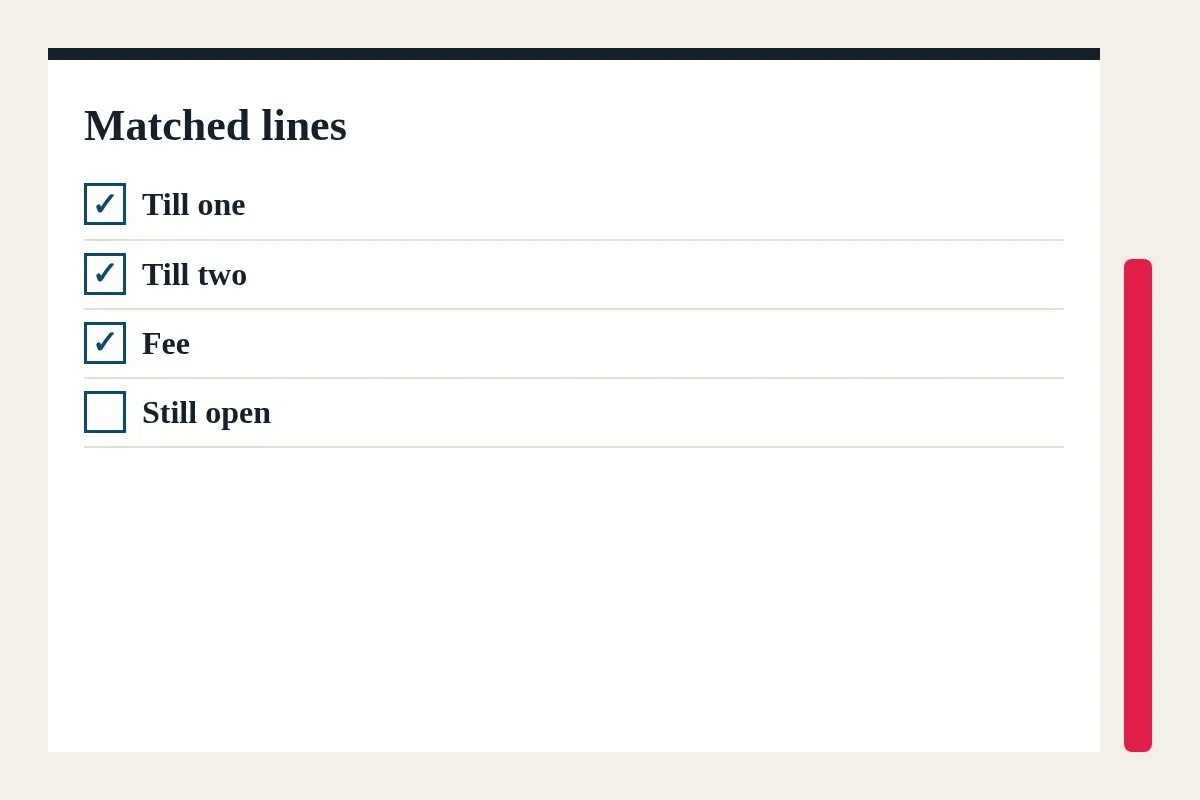
A hypothetical month, amounts left off
Read A hypothetical month, amounts left off
Say an owner billed a job in the program the crew uses, and also typed an invoice in the books so the deposit would have somewhere to land. The customer paid once. Two invoices are open. Nothing on this page is that owner's number. The shape is the lesson.
First we decide which invoice survives. The field invoice has the description the customer already saw, so it survives, and the books invoice is voided with a note that names its twin. Second we split the deposit. The gross closes the invoice. The processor fee becomes an expense. Third we reconcile. The bank now agrees without a plug.
Only then do we look at sales tax. The surviving invoice is the sale. Treating the voided invoice as a second sale, or as a refund, would invent a return that fixes a mistake by making a new one.
What the strip would show, with the amounts missing
Read What the strip would show, with the amounts missing
The month, tied to the bank or still open. The pair of invoices, with one marked as the survivor. What you send, which is access, the last close you trusted, and the question. What waits, which is any signature this practice does not hold. That is the whole strip. Printing a balance on it would turn a shape into someone else's file, so the balance stays off.
If your month rhymes with this one, you already know the next step. If it does not, the questions page is a better door than forcing your fact into this story. Hypotheticals are useful only when the reader can tell they are hypotheticals.
Why we refuse a case story
Read Why we refuse a case story
A real file has a name, a bank, and a number of dollars that belong to one company. None of that is a teaching tool. The made up month keeps the sequence and drops the identity. If a sentence on this page ever sounds like a client, it will be rewritten the same day.
The form below is for your month, not for this invented one. Tell us which program billed the work. Leave the amounts for the call.
Does your month rhyme
If the invented month is close to yours, name the program. Leave the amounts for the call.

You will be talking to the Steven Palmieri practice.
What to read next
The order, written so you can check your own week
Read The order, written so you can check your own week
Day one, pick the invoice the customer already received. Day two, void the twin and write the survivor's number on the void. Day three, split the deposit between the gross and the fee. Day four, reconcile, and leave anything older than a season on a list you can see. Day five, ask whether sales tax was computed on the survivor only. That is five small jobs. None of them needs a balance printed on a website.
If your week cannot follow that order because the customer was billed three times, or because the payment was cash in a drawer, the hypothetical has done its job by failing. Tell us the real shape. A hypothetical that almost fits is more dangerous than one that does not, because people force the last inch.
We keep this page free of names on purpose. If a later edit ever adds a city block, a dollar total, or a trade that sounds like one company, that edit gets pulled. Teaching is allowed. Borrowing someone's month is not.